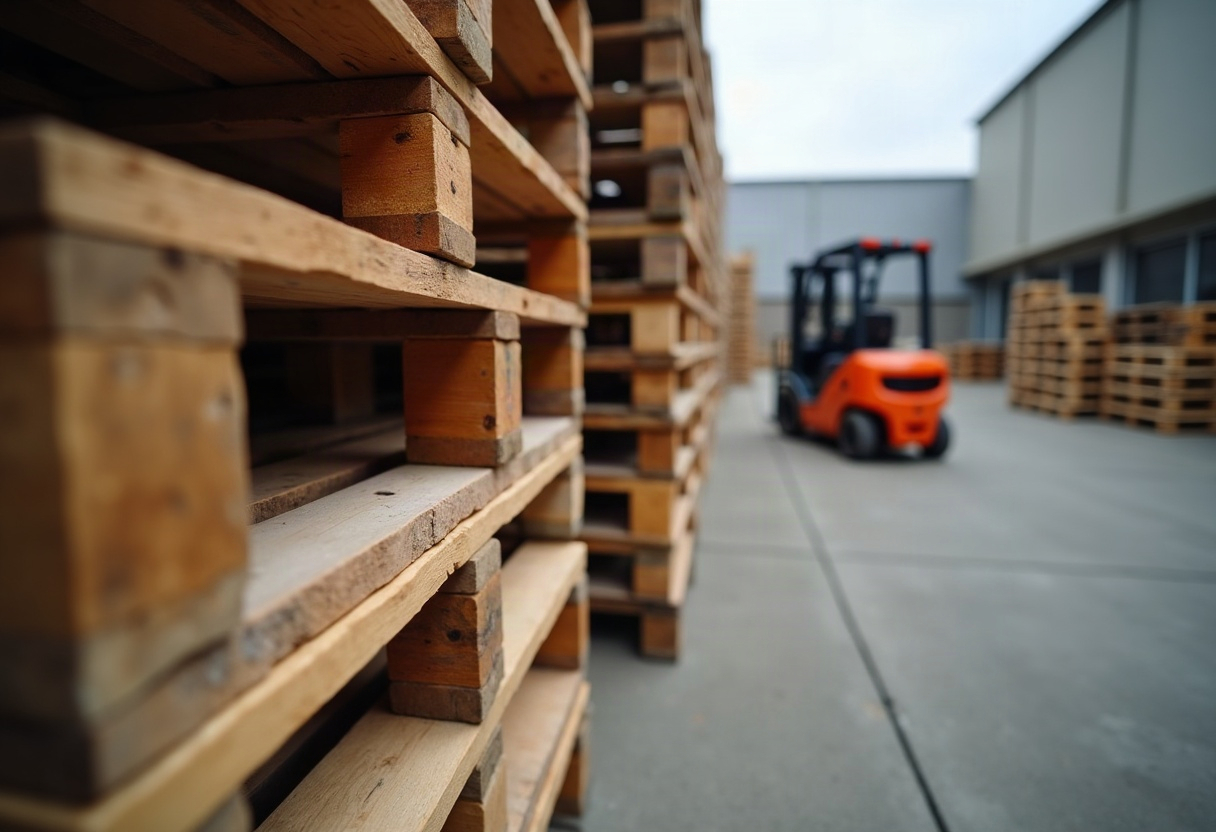
If your business accumulates empty pallets, you have probably searched "who buys wooden pallets near me" at least once. The answer is more layered than the search results suggest. Washington has a real market for used pallets — buyers, recyclers, repair shops, and scrap haulers all compete for the same wood — but who pays the best and picks up depends on what you have, how much of it, and where you are.
This is the guide we give customers who call us asking where to sell pallets in Kent, Renton, Auburn, Seattle, and the South Sound. It covers who buys, what they pay, what condition matters, and how to actually get rid of a stack of pallets without paying landfill fees.
Who Actually Buys Wooden Pallets in Washington
The "who buys wooden pallets" search returns three different kinds of buyers. Understanding which one you are calling changes the price you get.
1. Pallet Recyclers and Refurbishers (Best Price for Standard Sizes)
This is the category we sit in. A pallet recycler buys used 48x40 GMA pallets (the grocery-grade standard size), inspects and repairs them, and resells them to businesses that need pallets at a lower price than new. Recyclers pay the best per-pallet rate for standard sizes because the resale margin is real — a repaired 48x40 sells for roughly half the cost of a new one, and the repair cost is low (a stringer patch and a board or two).
Recyclers are also the buyers most likely to offer pickup. We run routes through Kent, Renton, Auburn, Tukwila, and South Seattle because the volume justifies the truck. If you have 50 or more standard pallets in reusable condition, a recycler is your best call.
2. Pallet Manufacturers (Buy Back Specific Sizes Only)
Some pallet manufacturers run buy-back programs for the exact sizes they build. If your business uses a custom or non-standard pallet — say a 42x42 or a 48x48 — the manufacturer who built it may take it back to refurbish. They rarely buy 48x40 GMA pallets because that is a commodity market they do not compete in.
Call the manufacturer if your pallets are odd sizes. If they are standard 48x40, skip this step and call a recycler.
3. Independent Scrap and Haul-Away Buyers (Best for Damaged or Mixed Loads)
Independent haulers run pickup routes for scrap-grade pallets — broken, off-size, water-damaged, or mixed loads that recyclers will not sort. They pay the lowest per-pallet rate (often $0.50 to $2) but they take what recyclers reject, and they will haul a mixed pile of broken and reusable pallets together.
If your business has a pile of broken pallets behind the dumpster and no one will touch them, a scrap hauler is the call. The money is small, but you avoid landfill fees (which run $15 to $30 per pallet as bulky waste) and the pile disappears.
What Buyers Pay — and What Drives the Number
Pallet pricing is not fixed. The number a buyer quotes depends on four things.
Size
The 48x40 GMA pallet is the gold standard. It is the size every grocery chain, every big-box distribution center, and every LTL carrier is set up to handle. Recyclers pay the most for it because demand is constant. Other sizes:
- 42x42 — used for beverages and some compressed-gas cylinders. Moderate demand, decent price.
- 48x48 — used for drums and bulk liquids. Specialty demand.
- 36x36 — beverage industry specialty. Lower demand.
- Odd sizes and custom builds — low demand, often scrap-grade pricing.
If you have a mix of sizes, expect the recycler to quote the 48x40s at one price and the rest at a lower price or as scrap.
Condition
A pallet's grade determines its price:
- Grade A (reusable, no repairs needed) — top price, $4 to $7 per pallet in the Puget Sound market.
- Grade B (needs minor repair — a stringer patch or one board) — $2 to $4 per pallet.
- Scrap (broken top boards, severe stringer damage, rot, contamination) — $0.50 to $2 per pallet, or free pickup.
Quantity
Recyclers price by the load. A pickup of 10 pallets may pay $3 each; a pickup of 200 pallets may pay $5 each because the truck trip is amortized across more units. The break-even for a dedicated route truck is roughly 50 pallets — below that, the haul cost eats the margin and the price drops.
Lumber Market
Used pallet prices track new pallet prices, which track lumber. When lumber spikes, new pallets get expensive, demand for repaired used pallets rises, and recyclers pay more. When lumber falls, used pallet prices soften. The range is not huge — a dollar or two per pallet — but it is real. Call for a current quote rather than relying on a price you got six months ago.
How to Find a Pallet Buyer Near You
The search "who buys wooden pallets near me" works, but the results are noisy — national lead-gen sites, directories, and a mix of recyclers and haulers. A more reliable approach:
- Search for "pallet recyclers [your city]" or "pallet buyers [your city]". This filters out the national lead-gen sites and surfaces the actual local businesses with yards and trucks.
- Call two or three. Get a per-pallet quote for your size and condition, and ask whether pickup is included. The quotes vary more than you would expect.
- Ask about minimum pickup quantity. Most recyclers will not send a truck for 10 pallets. The floor is usually 50. Below that, you deliver to the yard or wait until you accumulate more.
- Ask what they do with broken pallets. A recycler who also grinds scrap is more useful than one who only takes Grade A — you can clear the whole pile in one call.
- Confirm the pickup schedule. Recyclers run routes on set days of the week. If your pickup window matters (a dock door you need to free up, a tenant complaint about the pile), book the route day.
For businesses in the Kent, Renton, Auburn, Tukwila, and South Seattle corridor, we run weekly routes and can usually get to a pile within a few days. Call us at the number on the contact page with your pallet count, sizes, and condition, and we will quote it on the spot.
What Condition Makes a Pallet Reusable
If you want to know whether your pallets are worth money or just worth hauling away, check four things:
- Stringers or blocks intact. The longitudinal boards (stringers) or blocks under a pallet are its skeleton. If one is split through, the pallet is repair-grade, not reusable. If multiple are broken, it is scrap.
- Top boards (deck boards) present and unsplit. A pallet with a missing or badly split top board is repair-grade. Multiple broken top boards push it toward scrap.
- No rot or water damage. A pallet that sat in a puddle for a season will have soft wood and may not hold fasteners. Recyclers reject these.
- No chemical or oil contamination. Pallets used to haul oil drums, chemicals, or food waste are rejected for reuse because the contamination transfers to the next load. These go to scrap or mulch only.
A quick field test: stand on the pallet and bounce. If it flexes significantly or you hear cracking, the stringers are compromised. A solid pallet does not move under a person's weight.
What to Do With Pallets No One Will Buy
Some pallets have no resale market: odd sizes in bad condition, chemically contaminated, or so broken they are firewood. For these, the options are:
- Wood recycling drop-off. King County and Pierce County both accept pallets as clean wood waste at transfer stations. The fee is lower than garbage rates because the wood gets mulched. Call ahead — not every station accepts pallets and some have size limits.
- Mulch or biomass buyers. Companies that grind wood waste for landscape mulch or biomass fuel will sometimes take pallets in bulk. The price is zero or minimal, but you avoid landfill fees.
- Give them away. Craigslist, Facebook Marketplace, and local buy-nothing groups will clear a pile of free pallets fast. Gardeners, DIYers, and small crafters take them. This is the fastest way to empty a dock door if you do not care about the money.
- Repair them yourself. If you have a workshop and a few tools, a broken 48x40 can be patched with a stringer block and resold. This is rarely worth the labor unless you have a steady stream and someone with time on their hands.
Why This Market Exists
Pallets are the most reused packaging product in the United States. A single 48x40 GMA pallet may pass through six or eight businesses in its life — a grocery chain, a recycler, a small manufacturer, a produce distributor, another recycler, and finally a grinder. The wood is valuable enough that the system is built to keep it circulating.
That is why "who buys wooden pallets near me" is a search with a real answer in every metro area in the country. In Washington, the concentration of distribution, manufacturing, and port activity in the Kent-Auburn-Renton corridor means there is a steady buyer for nearly every pallet that comes off a truck. You are not stuck with a pile — you are sitting on a small revenue stream you have not collected yet.
If your business has pallets piling up — standard, broken, or mixed — give us a call. We buy 48x40 GMA pallets in any condition, run pickup routes across South King County and the South Sound, and will quote your pile the same day. The call takes two minutes and the dock door gets freed up by the end of the week.