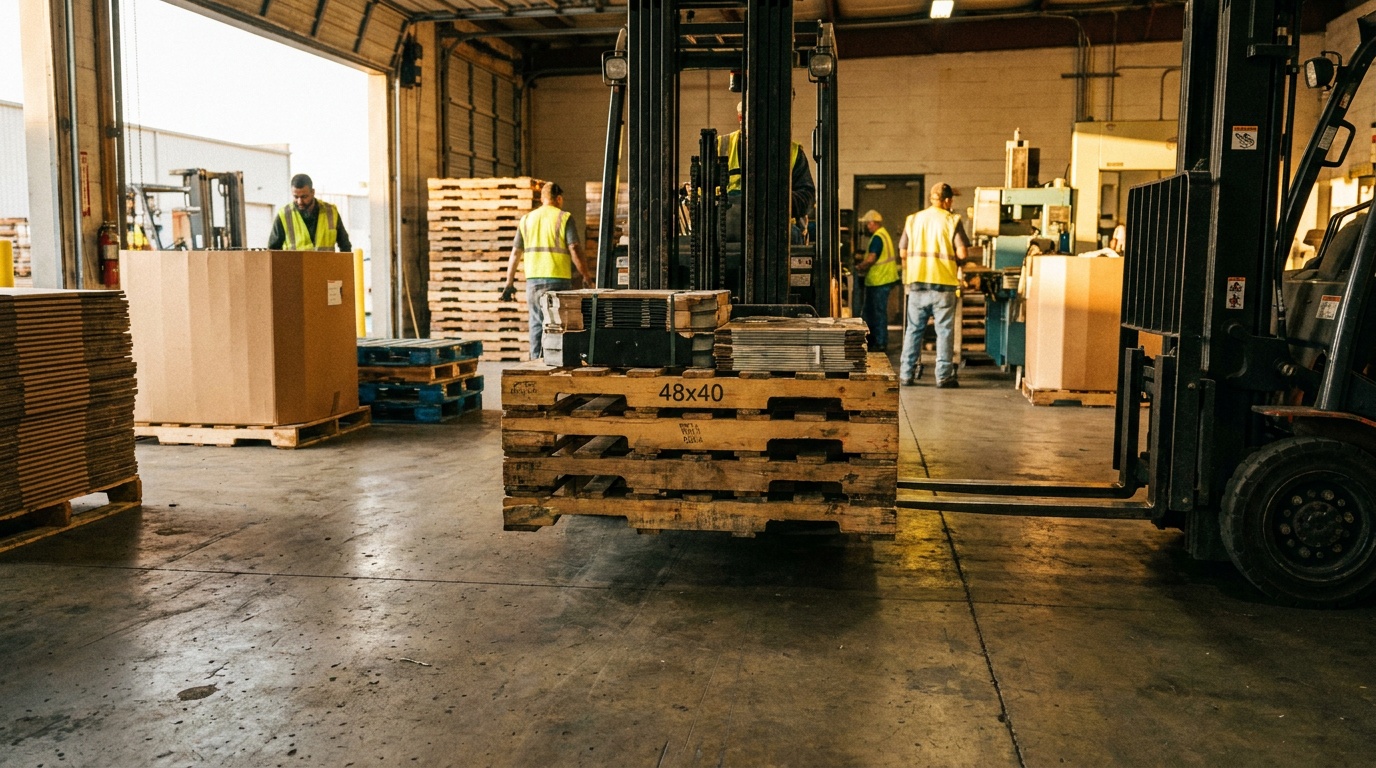
If you buy, sell, or ship products on pallets, the numbers matter more than you think.
A pallet that's too small wastes space in your truck. A pallet that's too heavy eats into your shipping weight allowance. A pallet that's too weak fails under load and damages your product—or worse, injures someone.
Understanding wood pallet weight and dimensions isn't just technical trivia. It's the difference between an efficient supply chain and a costly mistake.
At A-1 Pallets Inc., we supply new, used, and heat-treated pallets to businesses across Washington State—from Kent and Renton to Seattle and Tacoma. Here's what we've learned about pallet specifications that actually matter.
The Standard Wood Pallet: 48x40 GMA
The 48-inch by 40-inch pallet is the industry standard in North America. It's called a GMA pallet because the Grocery Manufacturers Association (now the Consumer Brands Association) established it as the standard for grocery distribution decades ago.
Today, roughly 30 percent of all new wood pallets produced in the United States are 48x40. It's the default size for general warehousing, manufacturing, and distribution.
Key specifications of a standard 48x40 GMA wood pallet:
- Length: 48 inches
- Width: 40 inches
- Height: 4.5 to 6 inches (varies by stringer thickness)
- Weight: 30 to 50 pounds (average 37 pounds)
- Static load capacity: Up to 4,600 pounds
- Dynamic load capacity: Up to 2,500 pounds
- Racked load capacity: Up to 1,500 pounds
The standard deck boards are 3.5 inches wide and about 0.5 inches thick. A typical 48x40 has 7 top deck boards and 5 bottom stringers.
Wood Pallet Weight by Type and Material
The weight of a wood pallet varies depending on several factors. Here's what to expect:
Standard GMA 48x40 Pallets by Wood Type
| Wood Type | Average Weight | Strength | Best For | |-----------|---------------|----------|----------| | Oak / Mixed Hardwood | 40–50 lbs | Highest | Heavy loads, repeated use, export | | Southern Yellow Pine | 30–40 lbs | High | General warehousing, moderate loads | | Aspen / Poplar | 20–30 lbs | Moderate | Light loads, one-way shipping, air freight |
Pallet Weight by Design
| Pallet Type | Average Weight | Use Case | |-------------|---------------|----------| | Light-duty stringer (2-way) | 15–25 lbs | Light loads, one-time use | | Standard stringer (2-way) | 30–40 lbs | General warehousing | | Block pallet (4-way) | 40–60 lbs | Heavy loads, frequent handling | | Heavy-duty pallet | 50–75 lbs | Extreme loads, industrial use |
The weight matters most when you're calculating freight costs. A heavier pallet means less product weight you can ship without exceeding truck or container limits. If you're shipping palletized goods regularly, choosing the lightest pallet that still meets your strength requirements can save thousands annually.
Wood Pallet Dimensions Beyond 48x40
While 48x40 is the standard, many industries use different sizes for specific applications.
42x42 (42 Square): Common in telecommunications and paint industries. Two-way or four-way entry. Used when a square footprint works better in the racking or shipping configuration.
48x48 (48 Square): The standard for transporting 55-gallon drums. Widely used in chemical, agricultural, and bulk material industries. The square shape accommodates heavy, round containers that don't fit well on rectangular pallets.
40x48: A variation of the standard size rotated 90 degrees. Some industries prefer this orientation for specific racking or conveyor systems.
36x36: A smaller footprint used in retail displays, beverage distribution, and tight warehouse spaces. Lighter and easier to maneuver.
48x45: Common in the automotive industry for transporting parts and components. Designed to fit specific racking systems used in automotive manufacturing.
56x44 and 44x56: Used in the glass and can industries respectively. These are larger pallets designed to support heavy, dense products like filled bottles or cans.
Pallet Dimensions Comparison Chart
| Pallet Size | Common Name | Typical Industries | Average Weight | |-------------|-------------|-------------------|----------------| | 48x40 | GMA Standard | Grocery, general warehousing, distribution | 37 lbs | | 42x42 | 42 Square | Telecommunications, paint, coatings | 36 lbs | | 48x48 | Drum Pallet | Chemical, agricultural, bulk materials | 37 lbs | | 40x48 | Rotated GMA | Specific racking/conveyor configurations | 42 lbs | | 48x45 | Automotive | Automotive parts manufacturing | 35 lbs | | 36x36 | Beverage | Beverage distribution, retail displays | 32 lbs | | 56x44 | Glass | Glass manufacturing and distribution | 45 lbs | | 44x56 | Can | Can manufacturing and beverage | 42 lbs |
Understanding Pallet Weight Capacity
A pallet's weight capacity isn't a single number. It depends on how the loaded pallet is being used.
Static load is the weight a pallet can hold when sitting flat on the floor or another pallet. This is the highest capacity rating because the weight is distributed evenly across the entire bottom surface. A standard 48x40 GMA pallet handles about 4,600 pounds static.
Dynamic load is the weight a pallet can hold while being moved by a forklift or pallet jack. The bottom deck boards bear the full weight at the fork points, so dynamic capacity is lower—about 2,500 pounds for a standard pallet.
Racked load is the weight a pallet can hold when stored on warehouse racking with only the outer edges supported. This is the lowest capacity rating because the center of the pallet bears the full weight without floor support. A standard pallet handles about 1,500 pounds racked.
Never exceed these limits. A pallet failure under dynamic or racked load can cause serious injuries, product damage, and warehouse downtime.
Pallet Height and Construction
The height of a wood pallet affects both storage and shipping. Standard pallets are 4.5 to 6 inches tall, but custom heights are available.
Stringer pallets (the most common type) use three horizontal 2x4 stringers running parallel to each other. The stringer height is typically 3.5 inches, with top and bottom deck boards adding another 0.5 to 1 inch each. Total height: 4.5 to 5 inches.
Block pallets use solid wood blocks instead of continuous stringers, which allows four-way forklift entry. Block pallets are typically 5 to 6 inches tall because of the block construction.
Skid pallets have no bottom deck—just a single deck surface on top of stringers. They're lighter (20 to 25 pounds) and shorter (about 3.5 inches), but they can't be stacked or stored in racking the same way.
Pallet Weight and Freight Costs
Here's where the numbers get practical.
If you're shipping a palletized load at 100 pounds per cubic foot and your pallet weighs 37 pounds, that pallet represents 37 percent of the total shipment weight. Switch to a lightweight pallet at 22 pounds, and you've freed up 15 pounds of capacity for product.
Over hundreds of shipments, those 15 pounds add up. Lightweight pallets cost more upfront—often 20 to 30 percent more than standard pallets—but the freight savings can offset the difference within weeks.
For export shipments, factor in the pallet weight when calculating landed costs. A heavy hardwood pallet needed for structural integrity on a long ocean voyage might be worth the extra weight. But for domestic shipments, lighter options usually make more sense.
How to Choose the Right Wood Pallet
Selecting the right wood pallet comes down to matching specifications to your actual use case.
Consider your product weight and dimensions. A pallet that's too small under-supports your product, leading to damage. Too large, and you're paying to ship empty space. Match the pallet footprint to your product footprint with at least 1 to 2 inches of overhang on all sides.
Consider your storage and racking setup. If your warehouse uses standard 48-inch deep racking, a 48x40 pallet is the obvious choice. If you use flow rack or automated systems, confirm the exact dimensional requirements before ordering.
Consider your shipping method. Truckload shipments can use heavier pallets because weight is less constrained. LTL (less-than-truckload) and air freight benefit from lighter pallets to reduce shipping costs. Ocean freight requires heat-treated or ISPM-15 certified pallets.
Consider handling frequency. Pallets that will be handled multiple times—moved in and out of racking, transferred between facilities—need higher durability. That means harder wood species, thicker deck boards, and reinforced construction.
Consider whether you need new, used, or heat-treated. New pallets are ideal for outbound customer shipments and regulated industries. Used pallets work well for internal handling and closed-loop logistics. Heat-treated pallets are mandatory for international shipping.
Pallet Types and Their Specs
Stringer pallets are the most economical and widely available. They use three parallel stringers (2x4s) running the length of the pallet. Two-way entry means forks can only enter from two opposite sides. Notched stringers allow partial four-way entry.
Block pallets use nine or more solid blocks instead of stringers. They offer full four-way entry, higher durability, and better weight distribution. Block pallets are more expensive but last longer and handle heavier loads. They're common in food and pharmaceutical supply chains.
Skid pallets are single-deck platforms without a bottom deck. Lightweight and low-cost, they're used for light loads and one-way shipping. They can't be stacked and don't work in racking.
Why Pallet Specifications Matter More Than You Think
The difference between the right pallet and the wrong one is rarely visible at first glance. Both look like wood and nails. But the wrong pallet causes problems that compound over time.
A pallet that's 1 inch too wide for your racking costs seconds every time it's put away. Over hundreds of picks per week, those seconds become hours. A pallet that's too heavy for your shipping mode costs dollars every time it ships. Over thousands of shipments, those dollars become tens of thousands.
At A-1 Pallets Inc., we've been helping Washington businesses get the right pallets for their specific operations for years. We stock new, used, and heat-treated pallets in standard and custom sizes. We deliver across Kent, Renton, Auburn, Seattle, Tacoma, and throughout the Pacific Northwest.
Need wood pallets that match your exact specifications? Contact A-1 Pallets Inc. for a quote. We'll help you choose the right pallet weight, dimensions, and type for your operation—and deliver them when you need them.
For a broader look at sourcing options, see our guide on where to buy wood pallets, or explore our complete pallet services including custom manufacturing, repair, and recycling.