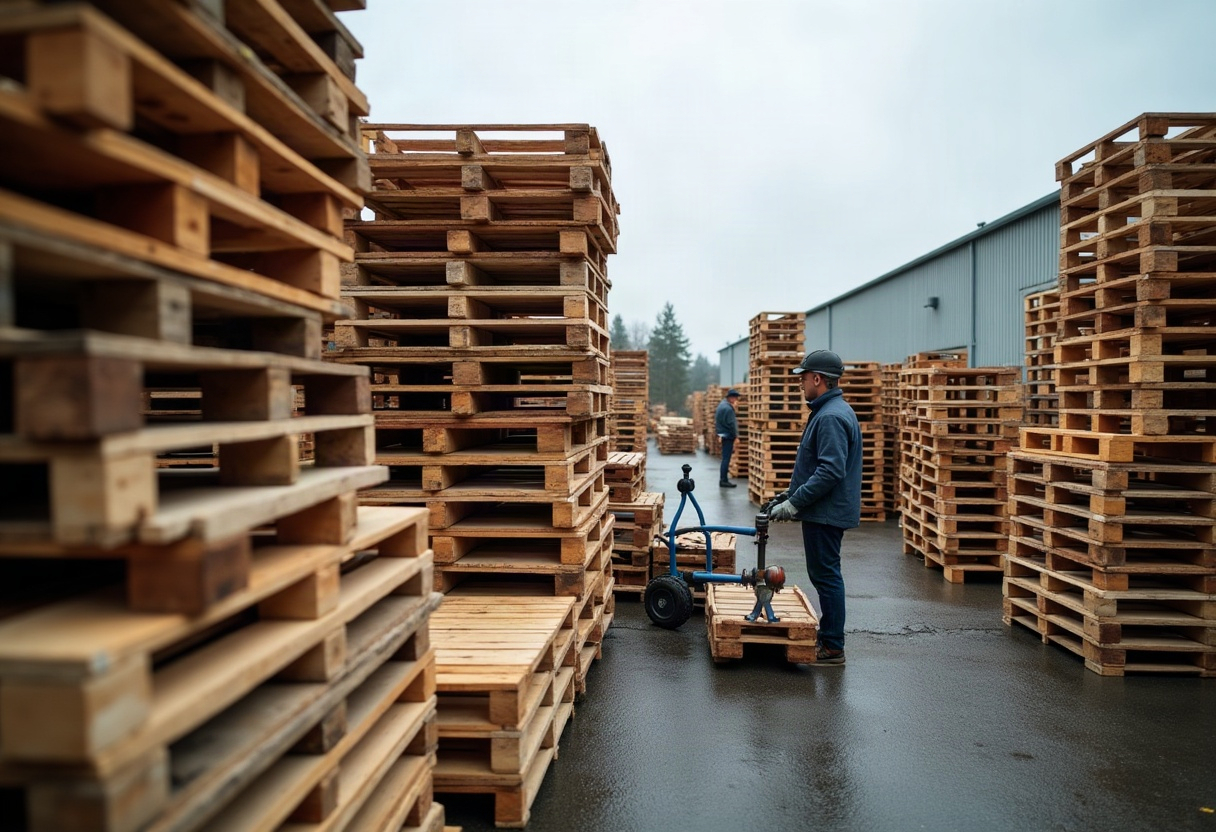
If your business ships freight, you generate used pallets. And if you are searching "pallet recycling near me," you are probably looking at a pile of empty pallets taking up warehouse space and wondering what to do with them.
The good news: in the Pacific Northwest, pallet recycling is not just available — it is a well-established industry. A-1 Pallets Inc. has been recycling pallets from our Kent, WA facility for over 22 years. This guide explains what happens to your used pallets, how the recycling process works, and why it matters.
What is pallet recycling?
Pallet recycling is the process of taking used, damaged, or surplus pallets and either repairing them for reuse or breaking them down into reusable materials. It is not the same as throwing pallets into a wood dumpster — recycling means every piece of wood is either put back into service or converted into a usable product.
The three outcomes for a recycled pallet are:
-
Repair and resale. A pallet with a few broken boards is disassembled, the broken boards are replaced with salvaged lumber from other pallets, and the repaired pallet re-enters the supply chain. This is the most common outcome for standard GMA 48x40 pallets.
-
Grinding into mulch or biomass. Pallets that cannot be repaired are ground into wood mulch, which is sold for landscaping, animal bedding, or biomass fuel. Nothing goes to the landfill.
-
Salvage of reusable components. Stringers, deck boards, and blocks from broken pallets are salvaged and used to repair other pallets. A single broken pallet may yield enough good lumber to repair three or four others.
How the pallet recycling process works
Step 1: Sorting
When used pallets arrive at our Kent facility, they are sorted by size, condition, and type. Standard GMA 48x40 pallets are separated from odd sizes. Pallets are graded as:
- Grade A — serviceable, no repairs needed
- Grade B — needs minor board replacement
- Grade C — needs significant repair or is unrepairable
Step 2: Repair
Pallets needing repair are disassembled using pallet busters or pry bars. Broken stringers and deck boards are removed and replaced with salvaged lumber from pallets that were too damaged to repair. The repaired pallet is then re-inspected and graded.
Step 3: Grinding
Pallets that cannot be repaired — ones with split stringers, broken blocks, or excessive damage — are fed into an industrial tub grinder. The resulting wood mulch is screened and sold for:
- Landscaping and garden mulch
- Animal bedding (after metal is removed)
- Biomass fuel for co-generation plants
- Composting feedstock
Step 4: Re-entry into the supply chain
Repaired pallets are stacked, counted, and made available for resale. Recycled pallets cost less than new pallets because the raw material (the pallet itself) was already manufactured — the recycler is only paying for labor and freight, not new lumber.
Why pallet recycling matters
It keeps wood out of landfills
Wood pallets account for a significant portion of industrial wood waste. In the Pacific Northwest, where port traffic generates a high volume of pallets, recycling infrastructure is robust — but only if businesses choose to use it. Every pallet that is recycled instead of landfilled saves roughly 15 to 20 pounds of wood from the waste stream.
It reduces demand for new timber
A repaired pallet uses zero new lumber. Every time a pallet is repaired and reused, the demand for newly harvested wood decreases. For a region that prides itself on sustainable forestry, pallet recycling is a natural extension of that ethic.
It lowers your pallet costs
Recycled GMA pallets typically cost 30 to 50 percent less than new pallets. If your business uses pallets in volume, the savings add up quickly. Even if you do not buy recycled pallets, recycling your surplus inventory can generate revenue through a pallet buyback program.
It frees up warehouse space
Empty pallets accumulate fast. A 5,000-square-foot warehouse can lose 500 square feet to empty pallet stacks in a month. Recycling or selling your surplus pallets reclaims that space for productive use.
How to recycle your pallets in the Pacific Northwest
A-1 Pallets Inc. offers pallet recycling and buyback services from our facility at 404 3rd Ave S, Kent, WA 98032. Here is how it works:
- Call (253) 395-3119 to discuss your pallet volume, sizes, and condition.
- Schedule a pickup or drop-off. We can send a truck to your facility for large volumes, or you can deliver pallets to our Kent yard.
- We sort and grade your pallets on-site and provide a buyback quote for serviceable inventory.
- Pallets are repaired, ground, or salvaged — nothing goes to the landfill.
We accept standard GMA 48x40 pallets, odd-size wood pallets, custom pallets, and broken pallets. The only pallets we cannot recycle are those contaminated with hazardous chemicals, oil, or paint.
A-1 Pallets Inc. is the largest privately-owned, family-owned pallet manufacturer in the Pacific Northwest. We have been operating from the Kent Valley for over 22 years, serving businesses throughout Washington, Oregon, and the broader PNW. Call (253) 395-3119 or email order@a1palletsinc.com to recycle your used pallets today.
Ready to recycle your pallets? Request a pallet pickup or buyback quote, explore our pallet logistics services, or learn where to drop off pallets near you.