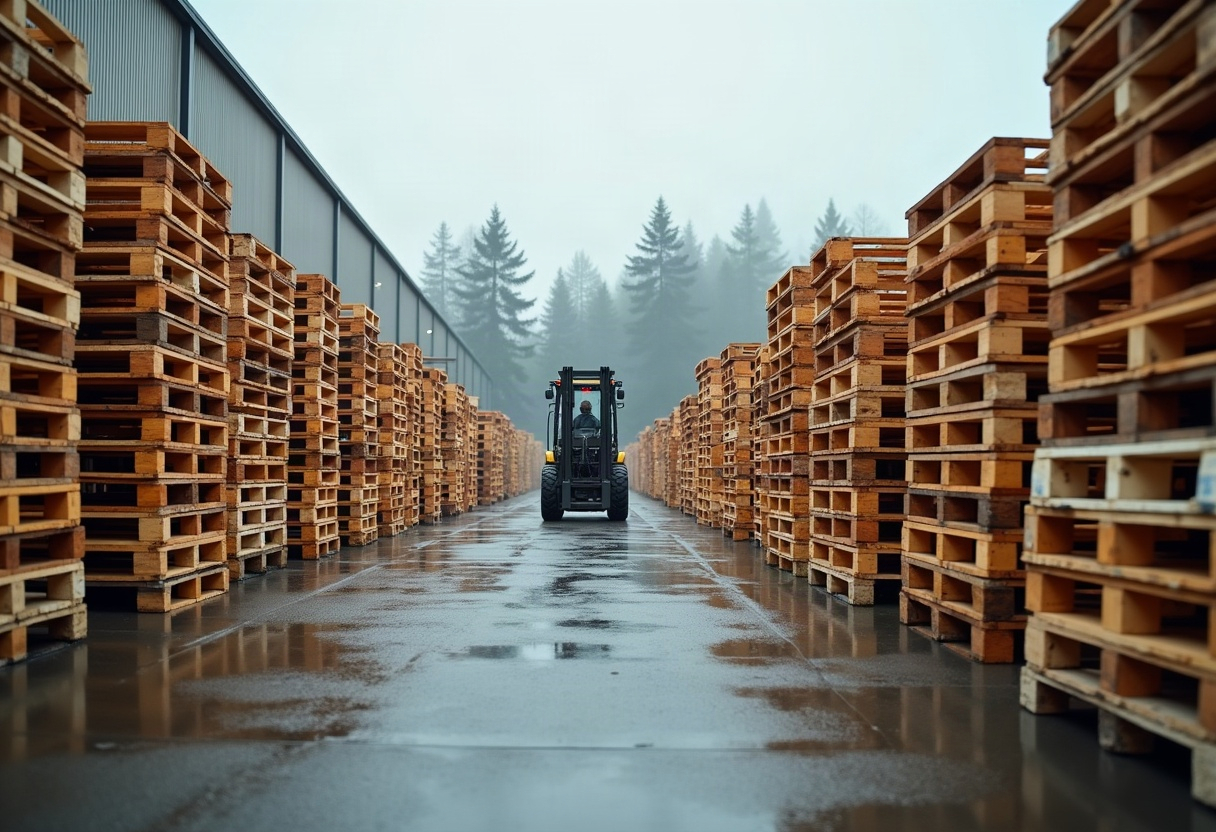
If your business moves any volume of product, your pallet supplier is not a vendor — they are part of your supply chain. A late delivery, a load of undersized pallets, or a batch that fails a customer's incoming inspection can shut down a shipping line for a day. We have seen it happen to companies across the Kent Valley and the I-5 corridor, and it is always expensive.
This guide breaks down what actually matters when you are evaluating pallet suppliers, whether you are buying 50 pallets a month or 5,000.
Pallet Grades: What You Are Actually Buying
Not all pallets are equal, and not all suppliers are honest about what they are selling you. Here is the breakdown:
Grade A (#1) GMA pallets are the gold standard. These are 48x40 pallets that have been inspected and repaired to near-new condition. No broken stringers, no missing boards, solid deck boards. If you are shipping to a big-box retailer or a distribution center with automated handling, this is what you need.
Grade B (#2) GMA pallets have one or two repaired stringers — usually a companion stringer bolted or nailed alongside a cracked one. They are structurally sound but will not pass every automated inspection line. They work well for internal warehouse moves, closed-loop logistics, or shipping to customers who are not picky.
Remanufactured pallets are built from reclaimed lumber and components. They are not the same as used pallets — they are newly assembled from recycled parts. Quality depends entirely on the supplier's build standards.
New pallets are built from fresh-cut lumber. They cost more, but they are the only option for food-grade, pharmaceutical, or export shipments that require ISPM-15 heat treatment certification.
A supplier who cannot tell you what grade they are selling you — or who mixes grades in a single load without telling you — is not a supplier you want to rely on. For more on pallet dimensions and standards, see our wood pallet weight and dimensions guide.
Certifications That Actually Matter
If you are shipping internationally, your pallets need to be ISPM-15 compliant. That means they are either heat-treated (HT) to 56°C core temperature for 30 minutes, or treated with methyl bromide (largely phased out). Every compliant pallet bears an IPPC stamp with the treatment method, country code, and facility number.
Domestic-only shipments do not require ISPM-15, but if your customer requires heat-treated pallets for their own QA program, your supplier needs to be able to provide them with documentation.
Ask your supplier:
- Can you provide ISPM-15 certificates on request?
- Do you have a heat-treat facility on-site, or do you send pallets out for treatment?
- Can you provide a letter of guarantee for FDA-compliant applications?
A supplier who hesitates on any of these questions is a red flag.
Pricing Structures: Reading Between the Lines
Pallet pricing is not as simple as "X dollars per pallet." Here is what to ask about:
Volume tiers. Most suppliers offer price breaks at 100, 500, and 1,000+ pallets per month. If you are growing, ask what it takes to move up a tier.
Delivery costs. Some suppliers include delivery within a radius; others charge per mile. If you are in Kent and your supplier is in Portland, that freight cost can add $1-2 per pallet. Our logistics service handles delivery across the Pacific Northwest with our own fleet, which keeps costs predictable.
Fuel surcharges. Some suppliers pass these through; others absorb them. Ask for their policy in writing.
Payment terms. Net 30 is standard for established accounts. New accounts may require prepayment or COD for the first few orders.
Contract vs. spot pricing. If you have consistent monthly volume, a blanket purchase agreement with fixed pricing for 6-12 months protects you from lumber market volatility. Spot pricing is fine for one-off needs but will cost you more over time.
Delivery Reliability: The Metric That Matters Most
Price is important. Delivery reliability is more important. A pallet supplier who quotes $0.50 less per pallet but shows up two days late has cost you more than you saved.
When evaluating a supplier, ask:
- What is your on-time delivery rate?
- Do you maintain inventory for recurring customers, or do you build to order?
- What happens if a delivery is late — do you have a backup plan?
- Can I talk to two or three of your current customers?
We have been supplying pallets to businesses in Kent, Auburn, Renton, and Tacoma for decades. Our yard on Central Avenue in Kent keeps a standing inventory for our regular customers, which means when someone calls at 7 AM needing 200 pallets by noon, we can usually make it happen. That kind of reliability is what separates a pallet supplier from a pallet seller.
New vs. Used vs. Remanufactured: Making the Right Choice
Your supplier should help you choose the right pallet type for your application, not just sell you whatever they have in stock.
- New pallets for export, food-grade, pharmaceutical, or any application requiring ISPM-15 certification
- Grade A used for retail distribution, automated handling lines, or customer-facing shipments
- Grade B used for internal moves, closed-loop logistics, or non-critical shipments
- Custom-built when standard 48x40 does not fit your product
If you are not sure what you need, check our guide to choosing a pallet company or get a quote — we will help you figure it out without a hard sell.
Why Local Sourcing Wins
National pallet brokers can quote low prices, but they cannot control the last mile. When a broker is sourcing from three different yards across the West Coast, quality varies by load and delivery times slip.
A local supplier with their own yard, their own trucks, and their own repair crew can:
- Inspect every pallet before it leaves the yard
- Deliver same-day or next-day within their service area
- Swap out problem pallets without a three-day freight claim process
- Adjust to your changing volume without a 30-day notice period
Our Kent headquarters and Auburn yard give us coverage across the Seattle-Tacoma metro. When a customer in Renton needs 500 pallets on short notice, it is a 20-minute drive, not a two-day freight window.
The Bottom Line
The right pallet supplier is one who knows what grade they are selling you, can produce certifications on demand, prices transparently, and shows up when they say they will. Everything else is marketing.
If you want to talk to a supplier who checks all four of those boxes, call us at 253-395-3119 or request a quote. We have been doing this from the same Kent yard for over 30 years, and we plan to keep doing it for 30 more.