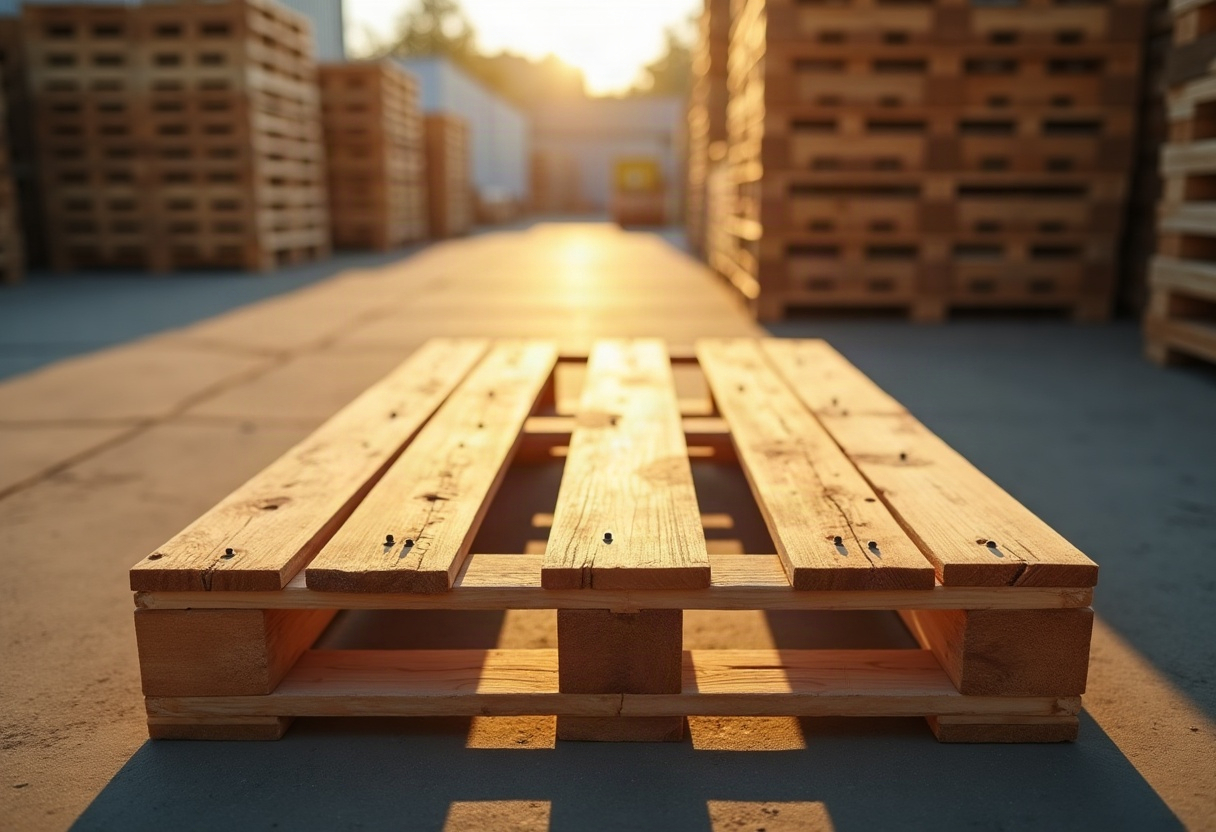
A failed pallet costs more than the pallet. When a stringer cracks under load, the cargo shifts. When a board splits on a forklift, the pick stops. When a pallet fails in transit, the freight claim follows. New pallets are not a luxury line item. They are the baseline for shipping reliability on loads where failure is not an option.
A-1 Pallets Inc. has been manufacturing new pallets at 404 3rd Ave S in Kent, WA for over 22 years. We are the largest privately-owned, family-owned pallet manufacturer in the Pacific Northwest. This guide covers what matters when you buy new pallets: standard sizes, export compliance, quality benchmarks, and the new-vs-used decision.
New Pallets vs Used Pallets
The choice comes down to what the pallet is carrying and where it is going.
Buy new pallets when:
- You ship high-value or fragile freight
- Your load crosses an international border
- You need consistent weight capacity on every pallet
- You are palletizing food, pharma, or regulated goods
- Your customer requires clean, unmarked pallets
Used pallets work when:
- You ship domestic, non-hazardous freight
- Your loads stay within standard weight ranges
- Cost per pallet matters more than lifespan
- You are running a closed-loop system where you get the pallets back
Used pallets have been in the supply chain. They may have repaired stringers, replaced deck boards, or nails that have loosened over time. That does not make them bad. It makes them a different tool for a different job. For a deeper breakdown of pallet condition grades, see our where to buy wood pallets guide.
The 48x40 GMA Standard
The 48x40 GMA pallet is the most common pallet in North America. GMA stands for Grocery Manufacturers Association, the body that set the standard decades ago. The dimensions are 48 inches by 40 inches. It fits standard forklifts, pallet jacks, conveyor systems, and racking without modification.
If you buy new pallets and do not need a custom size, 48x40 is the default. It is what most warehouses, distribution centers, and retailers expect. For full specs on weight capacity and dimensions, see our 48x40 pallet guide.
A standard new 48x40 stringer pallet weighs 35 to 45 pounds and carries a static load of 3,000 to 4,000 pounds. Dynamic load capacity — what it carries while moving on a forklift — runs 1,500 to 2,000 pounds. These numbers vary by lumber grade and construction. The point is that a new pallet hits its rated capacity on the first trip. A used pallet may not.
ISPM-15: Export Compliance
If your freight crosses an international border, your pallets must meet ISPM-15. ISPM-15 is the International Standards for Phytosanitary Measures No. 15. It requires wood packaging to be heat-treated or fumigated with methyl bromide to eliminate pests. Non-compliant pallets get rejected at customs.
New pallets can be built and heat-treated at the time of manufacture. The pallet gets stamped with the ISPM-15 mark — a wheat stamp icon, the country code, the treatment facility code, and the treatment method (HT for heat treatment, MB for methyl bromide). That stamp is what customs agents check.
If you ship to Canada, Mexico, or overseas, specify ISPM-15 compliant new pallets when you order. Retrofitting a used pallet for export compliance is not always practical. For more on treated wood requirements, see our guide on are pallets treated wood.
Quality Standards: What to Check
Not all new pallets are built the same. When you order new pallets, check these four things:
-
Lumber grade. New pallets should use #1 or #2 grade lumber. #1 grade is clear wood with minimal knots. #2 allows tight knots and is common for stringer pallets. Avoid pallets built with rejects or off-grade stock.
-
Moisture content. Green lumber has high moisture. Kiln-dried lumber is stable. Pallets built from wet wood shrink as they dry, which loosens nails. Ask whether your new pallets are built from kiln-dried or green lumber.
-
Nail count and pattern. A standard 48x40 stringer pallet uses 9 to 11 nails per stringer. Missing nails or inconsistent patterns mean the pallet will flex and fail early. Inspect a sample from each batch.
-
Corner blocks and stringers. Stringers should be solid, not glued or spliced. Corner blocks on block pallets should be flush. Any gap between the stringer and the deck board is a failure point.
For a reference on pallet weights and construction tolerances, see our wood pallet weight and dimensions guide.
Custom Pallet Sizes
Not every load fits a 48x40. If you ship oversized products, heavy machinery, or goods with unusual dimensions, a custom pallet prevents cargo overhang and load instability. Custom pallets are built to your specs — length, width, height, stringer thickness, and deck board count.
A-1 Pallets Inc. manufactures custom pallets alongside standard sizes. We build to your load requirements and delivery schedule. For details on how custom pallets work, see our custom pallet solutions guide.
How to Order New Pallets
Ordering new pallets from A-1 Pallets is a phone call. Here is what to have ready:
- Quantity — how many pallets you need per delivery
- Size — 48x40 standard, or custom dimensions
- Treatment — ISPM-15 compliant for export, or domestic use
- Lumber grade — #1, #2, or as specified by your freight requirements
- Delivery address — your facility location in the Pacific Northwest
Call (253) 395-3119 or email order@a1palletsinc.com. We are open Monday through Sunday, 8:00 AM to 4:00 PM. Our facility is at 404 3rd Ave S, Kent, WA 98032.
We deliver new pallets to businesses across Kent, Renton, Auburn, Seattle, Tacoma, and the broader Pacific Northwest. If you are ready to order or need a quote on a bulk run, start here.
The Bottom Line
New pallets are the right call when the load matters. They carry their rated weight on the first trip. They meet export compliance. They do not have hidden repairs. The upfront cost is higher than used, but the failure rate is lower. For shipping reliability on high-value, export, or regulated freight, new pallets are not an upgrade. They are the standard.
A-1 Pallets Inc. has been building new pallets in Kent, WA for over 22 years. We are the largest privately-owned pallet manufacturer in the Pacific Northwest. Call (253) 395-3119 to place an order.