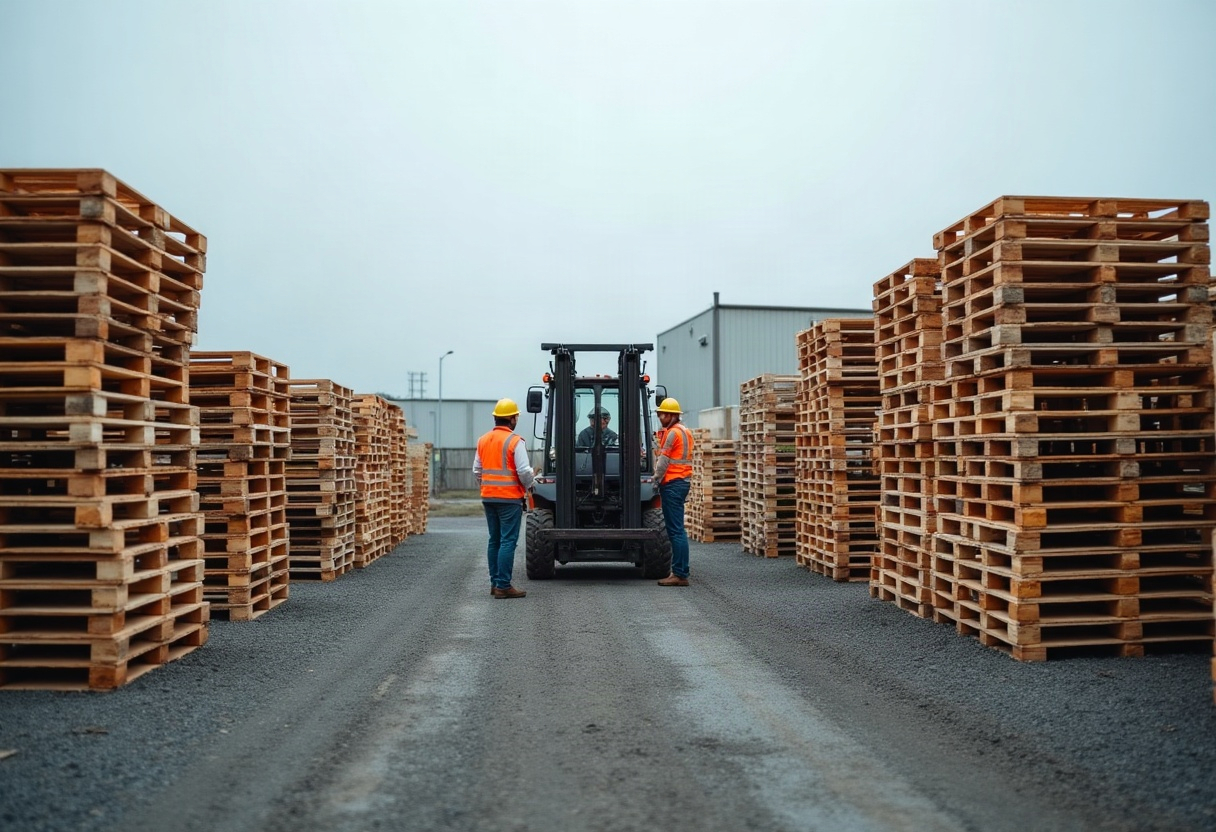
Pallet grades tell you what a pallet has been through and what it can still carry. When you buy used or recycled pallets, the grade is the single piece of information that determines whether that pallet is right for your load, your customer, and your budget. This guide explains what the common pallet grades mean, how the grading systems compare, and how a pallet moves from a returned shipment to a sorted, saleable product ready for its next trip.
Why Pallet Grades Exist
Pallets are reusable assets. A single 48x40 stringer pallet might complete dozens of freight trips before it wears out. But every trip leaves a mark: a cracked stringer, a split deck board, a nail that worked loose under load. The grading system exists so buyers can compare pallets on condition rather than guessing at quality from a photo or a phone description.
Without grades, every "used pallet" is a mystery. With grades, a buyer in Kent ordering a truckload of Grade B pallets knows exactly what is arriving: pallets that are functional, repaired where needed, and priced below a Grade A load for the same volume. Grades turn a subjective condition into a tradeable specification.
The Two Common Pallet Grading Systems
The pallet industry uses two overlapping grading systems. They describe the same condition tiers, but different regions and recyclers prefer one label set over the other.
The A/B Letter System
The A/B system is the most common grading standard for GMA (Grocery Manufacturers Association) 48x40 stringer pallets in North America.
- Grade A (premium / like-new): Pallets with intact stringers, solid deck boards, tight nails, and minimal wear. A Grade A pallet may be a repaired pallet that was fixed so well it looks and performs like new, or it may be a pallet that barely saw service. There are no companion stringers (the reinforcement strips nailed alongside a repaired rail) and no patched deck boards. Grade A is the top condition tier for a used pallet.
- Grade B (refurbished): Pallets that needed real repair work. A Grade B pallet has at least one repaired component, typically a companion stringer, a replaced deck board, or renailing across several joints. It is structurally sound and carries a standard domestic load safely, but it shows its repair history. Grade B is the workhorse tier for cost-driven high-volume shipping.
- Grade C (core / cull): Pallets pulled from circulation because they are too damaged to repair economically. These are broken down for usable parts or processed into mulch and biomass. Grade C pallets are not resold for shipping.
When you call a supplier and ask for "used pallets," you are buying Grade A or Grade B. The price gap between them is the repair labor and the cosmetic difference.
The #1 / #2 Number System
The number system runs in parallel to the letter system and is favored by some regional recyclers and pallet exchanges.
- #1 grade: Broadly equivalent to Grade A. A #1 pallet is structurally sound, clean, and ready for reuse with little to no repair history.
- #2 grade: Broadly equivalent to Grade B. A #2 pallet is functional but carries visible repair evidence such as companion stringers or patched deck boards.
Some yards split these further into #1 Premium and #1 Standard, or A Premium and A Standard, to distinguish between a near-new pallet and one with light cosmetic wear. These sub-grades are not standardized across the industry. If a supplier offers "Premium A" pallets, ask them to define what that means in their yard before you commit to a volume.
How Pallets Are Sorted and Graded
Grading happens during the recycling process, after a pallet is collected and before it is resold. The workflow is consistent across reputable yards.
- Collection. Used pallets arrive at the yard from pickups, drop-offs, and volume returns from distribution centers. For more on how that intake works, see our guide on pallet recycling near me.
- Inspection. Each pallet is inspected for the four failure points: stringer cracks, deck board splits, nail tightness, and block integrity on block pallets. A pallet that passes with minimal wear is tagged Grade A.
- Repair. Pallets that need work go to the repair bench. Broken stringers get companion reinforcement or replacement. Split deck boards are swapped. Loose joints are renailed. A repaired pallet that meets the Grade B standard is tagged and stacked.
- Culling. Pallets too damaged to repair are pulled for parts or mulch.
- Stacking by grade. Repaired and inspected pallets are stacked into grade-separated inventory. A buyer ordering Grade B gets a stack of Grade B, not a mix.
The sorting step is what makes grades trustworthy. A yard that skips sorting ships mixed condition, and the buyer absorbs the risk.
How A-1 Pallets Grades Used Pallets in Kent, WA
A-1 Pallets, Inc. has been buying, repairing, and selling used pallets at 404 3rd Ave S in Kent, WA for over 22 years. We are the largest privately-owned, family-owned pallet operation in the Pacific Northwest. Our recycling process follows the same sort, inspect, repair, and reintegration sequence described above.
When a load of used pallets arrives at our Kent yard, we sort them by condition. Each pallet is inspected for stringer cracks, deck board splits, nail tightness, and block integrity. Pallets that pass with minimal wear are classified as Grade A. Pallets that need repair are fixed with quality lumber and classified as Grade B. Damaged pallets that cannot be repaired are broken down for parts or recycled. The result is grade-separated inventory a buyer can order against with confidence.
To confirm what grades and sizes are in stock today, call (253) 395-3119.
Why Grade Matters for Buyers
The grade you choose should match the load, the destination, and the customer.
Choose Grade A or #1 when:
- The load is high-value and a pallet failure means a freight claim.
- Your customer specifies clean, unmarked pallets for retail or display.
- The pallet will be visible to the end recipient.
- You are palletizing goods that require a stable, pristine platform.
Choose Grade B or #2 when:
- You ship domestic, non-hazardous freight within standard weight ranges.
- Your operation runs a closed-loop system where pallets return to you.
- You need high volumes and cost per pallet is the constraint.
- The pallet is a shipping platform, not a display surface.
Neither grade is right for every shipment. A Grade B pallet on a high-value load is a risk. A Grade A pallet on a bulk closed-loop shipment is wasted spend. Matching the grade to the job is where the savings are.
When New Pallets Are the Right Call
Used pallets of any grade are not suitable for every load. Export shipments that cross an international border require ISPM-15 heat-treated pallets, and food, pharmaceutical, or regulated goods typically demand new pallets for compliance and traceability. For those shipments, see our new pallets guide and our overview of are pallets treated wood. New pallets are also the right choice when you need a non-standard size, which is where our custom pallet solutions come in.
Pallet Grades and the 48x40 Standard
Most graded used pallets in the Pacific Northwest are 48x40 GMA stringer pallets, the standard size for grocery and general freight. The grading systems above are built around that format. If you are buying a different size or a block pallet, ask the supplier how they grade it, because the A/B and #1/#2 systems were designed for 48x40 stringers. Our 48x40 pallet guide covers the dimensions and load ratings for that standard.
Choosing a Supplier That Grades Honestly
A grade is only as good as the yard assigning it. A supplier that mixes grades in a single load, or that labels repaired pallets as Grade A to justify a higher price, undermines the whole system. When you evaluate a pallet supplier, ask three things:
- Do they sort and stack by grade, or ship mixed condition?
- Can they tell you the repair criteria that separate their Grade A from their Grade B?
- Will they let you walk the yard or send condition photos before you commit to a volume?
For more on evaluating suppliers, see our guide on pallet suppliers. If you want to discuss what grade and volume fits your operation, contact us and we will walk you through what is in stock at the Kent yard.